The War Memorial monument in Floriana.
Malta
203 Archival description results for Malta
Gruppetta with a woman leaning on the railing at the Upper Barraka Gardens with a view of the Grand Harbour behind them.
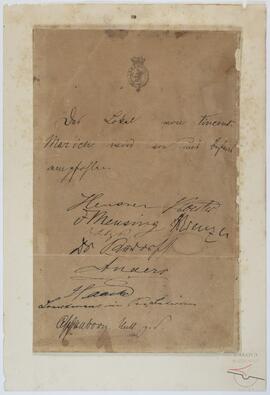
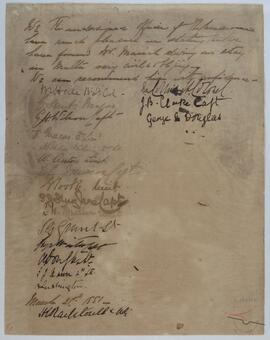
Testimonial letter from the 1st/20th Regiment of East Devonshire. It was signed just before they embarked on HMS Himalaya on the 17th January 1881.
Testimonial letter from Sir Leslie Rundle, Governor of Malta between 1909-1915, showing his satisfaction in the services and products received from V. Marich and Co.
A Bank of England cheque of £1.17s.6d for cigarettes supplied to His Royal Highness, The Prince of Wales.
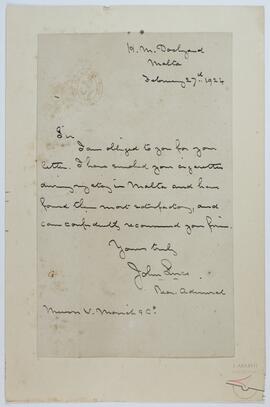
Testimonial letter from Rear Admiral John Luce, CB (4th February 1870 - 22nd September 1932).
Admiral Luce was a senior officer in the Royal Navy during and after the First World War. He played a significant role in the early development of the British Naval aviation. In 1921, Luce was appoined Admiral Superintendent, Malta Dockyard.
Testimonial letter from The Albemarle Club in London for the products supplied by V. Marich and Co.
A letter of thanks for a framed photograph of the 1968 letter of commendation provided by V. Marich and Co. to Lieutenant Colonel G. Lindsay Oliver and the Officers 1st Batalion The King's Regiment of Liverpool.
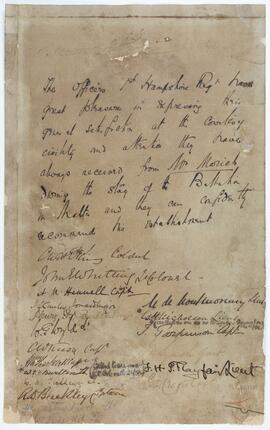
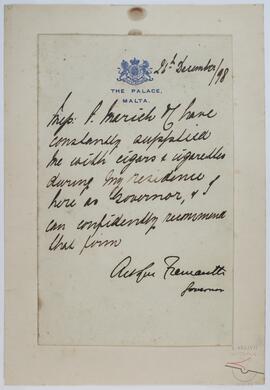
Testimonial letter praising the products of V. Marich and Co.
A letter dated 1st December 1922 indicating that the V. Marich and Co. establishment received another appointment as cigarette manufacturers to His Royal Highness, The Prince of Wales. This follows the first permission dated 4th November 1862.
Sir Herbert Plumer was sailing to Malta when the Sette Giugno riots took place in Malta. He arrived three days after the riots, where four (4) people were killed. By August 1919, the National Assembly had drafted a Constitution whereby a local government would deal with local matters, such as civil legislation, public instruction and finance. Items of imperial interest (defence, naval and military services and functions) would be dealt with by Westminster. Governor Plumer was appointed Governor of Malta by 1921 and held his post till 1924.
A government was formed following elections and the formulation and inauguration of the new parliament took place on the 1st November 1921.
UntitledSir Herbert Plumer was sailing to Malta when the Sette Giugno riots took place in Malta. He arrived three days after the riots, where four (4) people were killed. By August 1919, the National Assembly had drafted a Constitution whereby a local government would deal with local matters, such as civil legislation, public instruction and finance. Items of imperial interest (defence, naval and military services and functions) would be dealt with by Westminster. Governor Plumer was appointed Governor of Malta by 1921 and held his post till 1924.
A government was formed following elections and the formulation and inauguration of the new parliament took place on the 1st November 1921.
UntitledPhoto shows a crowd of people gathered in front of St George's Square in Valletta. It is not sure whether they are gathered for the new Governor of Malta, Sir Herbert Plumer, who read out the text of the Constitution on the 30th April 1921 or for the formulation and inauguration of the new parliament took place on the 1st November 1921.
UntitledA group of women and children by the water's edge. One of the children is suspected to be Arthur Wait.
Aerial view of HMS Falcon, 1957. Presumably taken as part of a publication.
The obverse of a greetings card, depicting a printed illustration of a view of Valletta from Lower Barracca.
This manuscript was written by Arthur Wait and proofread and edited by Sandra Blake of the National Archives of Malta. The author dedicated this book to "all Maltese boy seamen who served in the Royal Navy aged fifteen years, and who joined HMS Ganges; some of whom are no longer with us. I salute you all".
In the interview Ettore Raffi shared memories regarding trade between Lampedusan fishermen, sailors and the Maltese. The Lampedusans used to consider Malta as a rich island because of the availability of tobacco, sugar, chocolate and bars of soap. He recalled relations between Maltese, Italian and British sailors, as well as the nightlife in Valletta, particularly related to Strait Street, and Maltese women. Ettore Raffi gave us his opinion about Maltese culture, the period between 1964-1979, the Dom Mintoff government and the changes after Independence.