Site: Marsaskala by: N/A
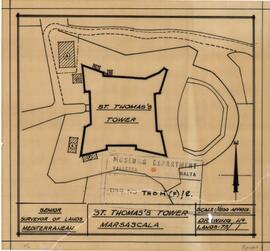
Senior Surveyor of Lands MediterraneanThe sepia-coloured image depicts the young St Thomas More (+1535) with the Holy Bible in his hands. St Thomas died a martyr after being indicted for high treason and consequently beheaded, the reason being because he opposed greatly King Henry VIII of England as regards to his divorce from his first wife Catherine of Aragon to marry Anne Boleyn and with the passing of the Act of Succession in 1534, which required all who should be called upon to take an oath acknowledging the issue of Henry and Anne as legitimate heirs to the throne. Besides this, More was also opposed to the papal supremacy as a royal proclamation ordered all clergy to acknowledge Henry VIII as 'Supreme Head' of the Church, and the laws against heritics. The image is a memento commemorating the feast of the Holy Family by the "St Thomas More" Circle in Hamrun run by the Male Section of the Catholic Action in Hamrun.
The image portrays a picture of St Therese of the Infant Jesus also known as St Therese of Lisieux and 'The Little Flower," who died in 1897 at the tender age of 24 years. She was a French Discalced Carmelite Nun. Overleaf, one finds a subscription in the Pontifical Society of the Holy Childhood (Santa Infanzia) founded in France in 1842 by Bishop Charles Forbin Janson to help children in mission lands, especially those in schools and orphanages. Overleaf, one finds a subscription written in blue ink of Lawrence and M'Anne Camilleri and the names given of Carmelo, Giovanna and Caterina. The funds collected are sent directly to mission dioceses in need by the Office of the Missions of 7 Merchants Str, Valletta.
This image depicts This image is the most popular picture of the Augustinian nun St Rita of Cascia (+ 1457) during one of her nightly meditations on the Passion of Christ, when a thorn from Christ's crown lodged itself in her forehead, causing a wound that never healed. The scourge on the wooden panel refers to a statement in her 'Vita' that she would scourge herself three times a day. The roses at the bottom of the image, next to the scourge, refer to the miracle by which roses grew for her in January. St Rita is the patron saint of Impossibilities. The two small angels at the top are holding a rose garland to crown the saint. This image is a memento commemorating the fifth centenary from the death of the Saint. Celebrations were held at the Church of St Mark run by the Augustinians in Rabat.
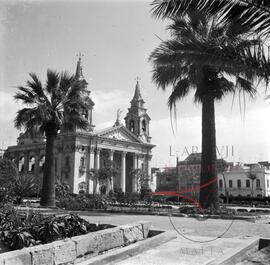
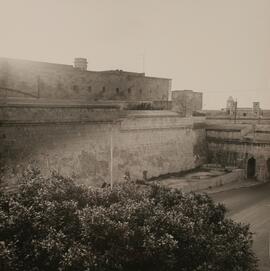
St Publius Parish Church and the Granaries